Tree Roots in a Sewer Line: What Removal and Repair Cost in the Bay Area
Getting tree roots out of a sewer line is usually a few-hundred-dollar job. HomeAdvisor's June 2026 cost data puts removal of a standard root intrusion at $100 to $600, and Fixr reports the same range. Fixing the joint the roots came through is where the real money goes: HomeAdvisor lists trenchless lining at $90 to $250 per foot and pipe bursting at $60 to $200 per foot. Which of those bills you end up paying depends on what a camera finds inside the pipe, not on how bad the backup looked.
This guide covers what roots in a sewer line cost to deal with, both the quick clearing and the permanent repair. The research behind it is older than most people expect. A review of root intrusion co-authored by a U.S. Forest Service scientist found that roots are reported to cause more than half of all sewer blockages, and that cut roots usually grow back. That second finding shapes almost everything below.
Maybe the lowest drain in the house backs up every winter and someone has already cleared the line twice. Maybe you are in escrow and the lateral video shows roots at every joint of an old clay pipe. Or you look after an older building where the street tree out front keeps winning. Each of those situations ends in a different bill.
Every price in this guide comes from a named national cost survey or a public agency, so you can check it yourself. Your own number comes after a camera inspection, and nothing here replaces that. By the end you will know what each fix costs, how to tell which one your pipe needs, and which Bay Area rules can raise or lower the total.
We have split it into four parts: what clearing costs, why it keeps coming back, what repair costs once the pipe is damaged, and the local rules on ownership, cost sharing, and root killers. Start with the number most people search for first.
How Much Does It Cost to Remove Tree Roots From a Sewer Line?
Removing tree roots from a sewer line costs $100 to $600 for a standard intrusion, according to both HomeAdvisor and Fixr. Most jobs also include a camera inspection, which HomeAdvisor prices at $100 to $500, and many plumbers clear roots with a hydro jetter, which HomeAdvisor puts at $350 to $600 for standard residential service.
| Service | National range | Source |
|---|---|---|
| Root removal, standard intrusion | $100 to $600 | HomeAdvisor (June 2026), Fixr (January 2025) |
| Sewer camera inspection | $100 to $500 | HomeAdvisor (June 2026) |
| Hydro jetting, standard residential | $350 to $600 | HomeAdvisor (June 2026) |
| Repair of a broken or cracked section | $600 to $1,050 | HomeAdvisor (June 2026) |
Those are national figures, and the Bay Area rarely lands at the bottom of a national range. Labor is most of a root job, and Bureau of Labor Statistics wage data for May 2025 puts the mean plumber wage at $44.41 an hour in the San Francisco metro area and $54.94 in the San Jose metro area, against $34.70 nationally. Expect local quotes toward the top of the table.
Say a Burlingame homeowner calls about a backup at the downstairs shower and gets offered two things: clear the line with a cable machine now, or jet it and run a camera first. The camera adds $100 to $500 on the day by HomeAdvisor's numbers. It is also the only way to learn whether that money is buying a one-time clearing or the first of many.
Why Clearing Roots Turns Into a Recurring Bill
Clearing roots removes the blockage but not the opening that let them in, so they grow back through the same joint. The review of root intrusion in sewer systems held in the U.S. Forest Service research library reports that cut roots usually grow back, often in greater numbers than before, and that in smaller pipes like house laterals, clearing every year or every other year is common.
So clearing works more like a subscription than a repair, and it can still be the right call. A sound pipe with roots at one or two joints might need attention every couple of years for a long time before it justifies a bigger fix. The same review estimated that for cities, root removal can run about one sixth the cost of renewing a root-damaged pipe, which is exactly why public works crews keep cutting. The math for your own lateral works the same way.
Picture a 1950s house in San Carlos with a 60 foot clay lateral and a mature tree near the front walk. At $350 a visit, the middle of the national removal range, clearing it once a year for eight years is $2,800, before any camera runs or a weekend emergency call. HomeAdvisor's per-foot lining range puts those same 60 feet at $5,400 to $15,000. Clearing stays cheaper for a long time, and in year nine you are still paying for it.
To work out where your own break-even sits:
- Ask what the camera showed after clearing, including where the roots got in and whether the pipe is cracked, offset, or sagging.
- Add up what one clearing really costs you, including the camera run and any after-hours premium.
- Divide a quote for the permanent fix by that number. That is how many clearings the fix is worth.
- Compare it with how long you plan to own the property. If you would pass the break-even while you still live there, get the fix priced properly.
What the Camera Shows Decides Which Fix You Need
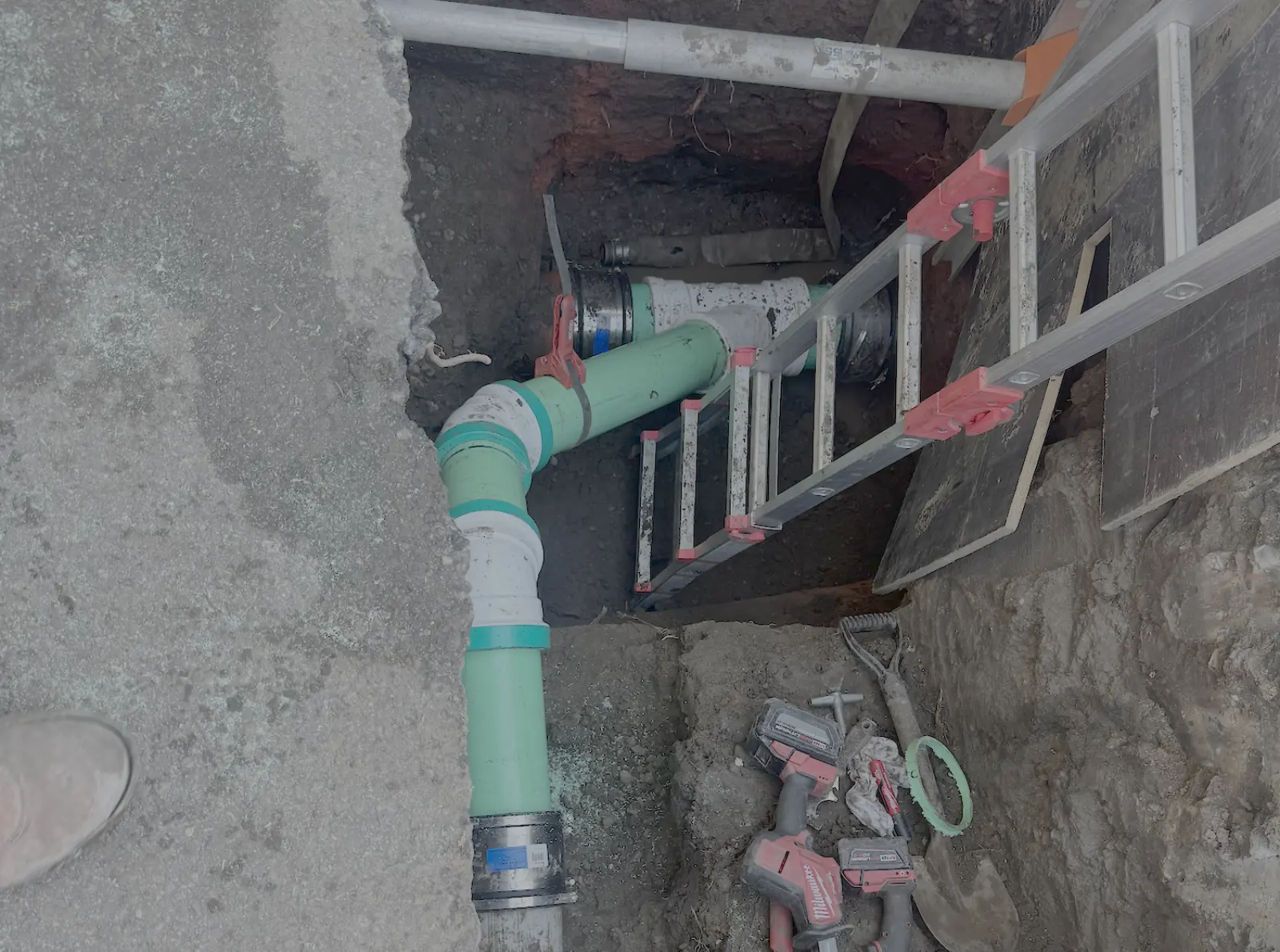
The camera footage, not the backup, decides whether you clear, line, or replace. Roots getting in at a few joints of a pipe that is still round and still slopes toward the street is a clearing or lining job. Roots plus cracks, shifted joints, or a sag is a repair job, and a collapsed or badly sagging line is a replacement.
- If the pipe is round, on grade, and rooted only at the joints, clear it, then choose between clearing on a schedule and lining the rooted section. A liner is one continuous pipe inside the old one, so the joints the roots used are gone.
- If the camera shows cracks or joints that have shifted out of line, price a spot repair or a short section liner at those points. HomeAdvisor lists repair of a broken or cracked section at $600 to $1,050 nationally, and a deep or paved-over dig costs more.
- If the line has collapsed, holds standing water in a sag, or is Orangeburg, plan on replacement. A liner cures to the shape of the pipe it sits in, sag included, which is why our guide to trenchless sewer repair costs walks through when lining cannot work.
Say you are buying in Millbrae and the lateral video you ordered shows roots at six joints of a clay pipe, with one joint visibly offset. Price that repair before you release your inspection contingency, while the seller is still at the table. Budgeting it as an annual clearing just moves the cost onto you.
What It Costs Once Roots Have Broken the Pipe
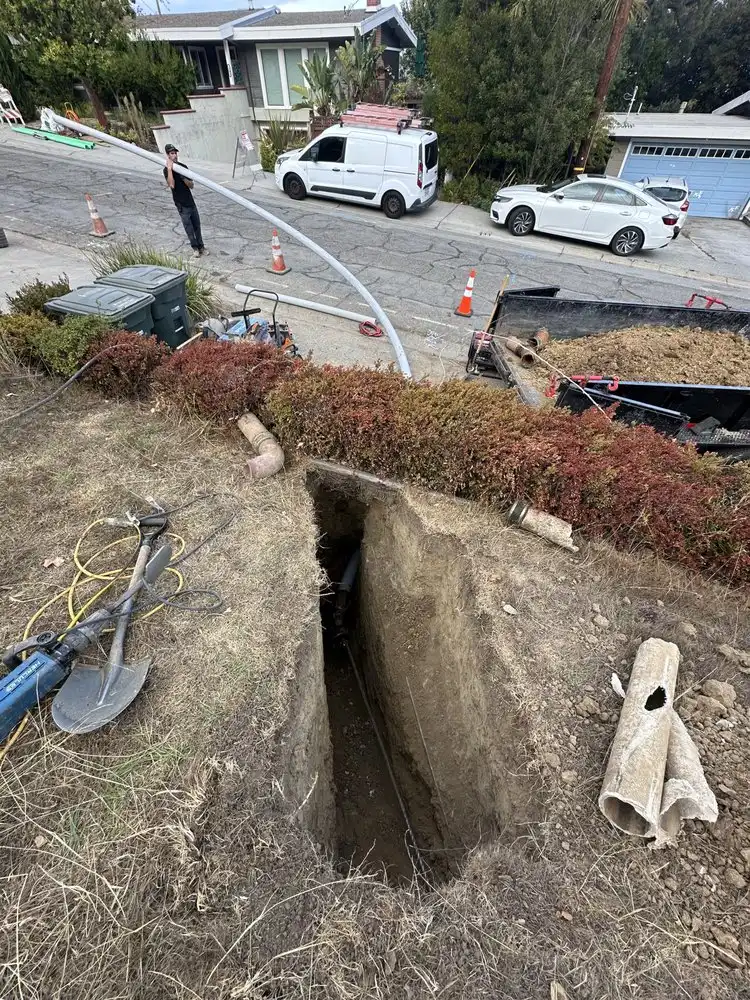
Once roots have cracked or displaced the pipe, you are paying repair prices, and the national per-foot ranges are the most useful numbers to start with. HomeAdvisor's June 2026 figures put CIPP lining at $90 to $250 per foot, pipe bursting at $60 to $200 per foot, and partial replacement at $50 to $250 per foot.
| Fix | National range | Source |
|---|---|---|
| Repair of a broken or cracked section | $600 to $1,050 | HomeAdvisor (June 2026) |
| CIPP lining | $90 to $250 per foot | HomeAdvisor (June 2026) |
| Pipe bursting | $60 to $200 per foot | HomeAdvisor (June 2026) |
| Partial replacement | $50 to $250 per foot | HomeAdvisor (June 2026) |
| Full sewer line replacement | $1,388 to $5,323 (average $3,319) | HomeAdvisor (June 2026) |
Treat the national total with care. An average job assumes an average line: short, shallow, and under lawn. Peninsula laterals can run longer, sit deeper, and pass under driveways and walkways that cost real money to put back, so multiply the per-foot ranges by your own footage instead. Our sewer lateral replacement cost guide covers the open-trench side of that decision, including how local permits and restoration add up.
What Raises the Price on a Peninsula Property
Access sets the price of a root repair more than the pipe does. Depth, the length of the run, what sits on top of it, whether there is a cleanout to work from, and whether the job reaches the street all move a Bay Area quote, often by more than the difference between two repair methods.
- A deeper lateral means a bigger excavation, and any trench five feet or deeper needs a protective system before anyone climbs in. That shoring is part of our excavation support scope and it shows up on the quote.
- Lawn is cheap to restore. Concrete driveways, pavers, and the tree itself are not, and they often push the choice toward trenchless.
- Without a cleanout near the house or the property line, there is nowhere easy to launch a camera, a jetter, or a liner, so adding one becomes part of the job.
- Damage near the connection to the public main takes the job into the street, which needs an encroachment permit and city-standard restoration. Menlo Park's current master fee schedule, effective July 1, 2026, charges $66 to issue a permit, $70 for plan check and $224.63 for inspection on a building sewer, and $1,064 for a minor encroachment permit that covers one lateral street opening.
- A sale adds a deadline. Hillsborough's municipal code requires the sewer lateral to be inspected when a home is sold, and repaired or replaced if necessary. A closing date takes the slow, cheap options off the table.
Who Pays When the Roots Come From a City Tree?
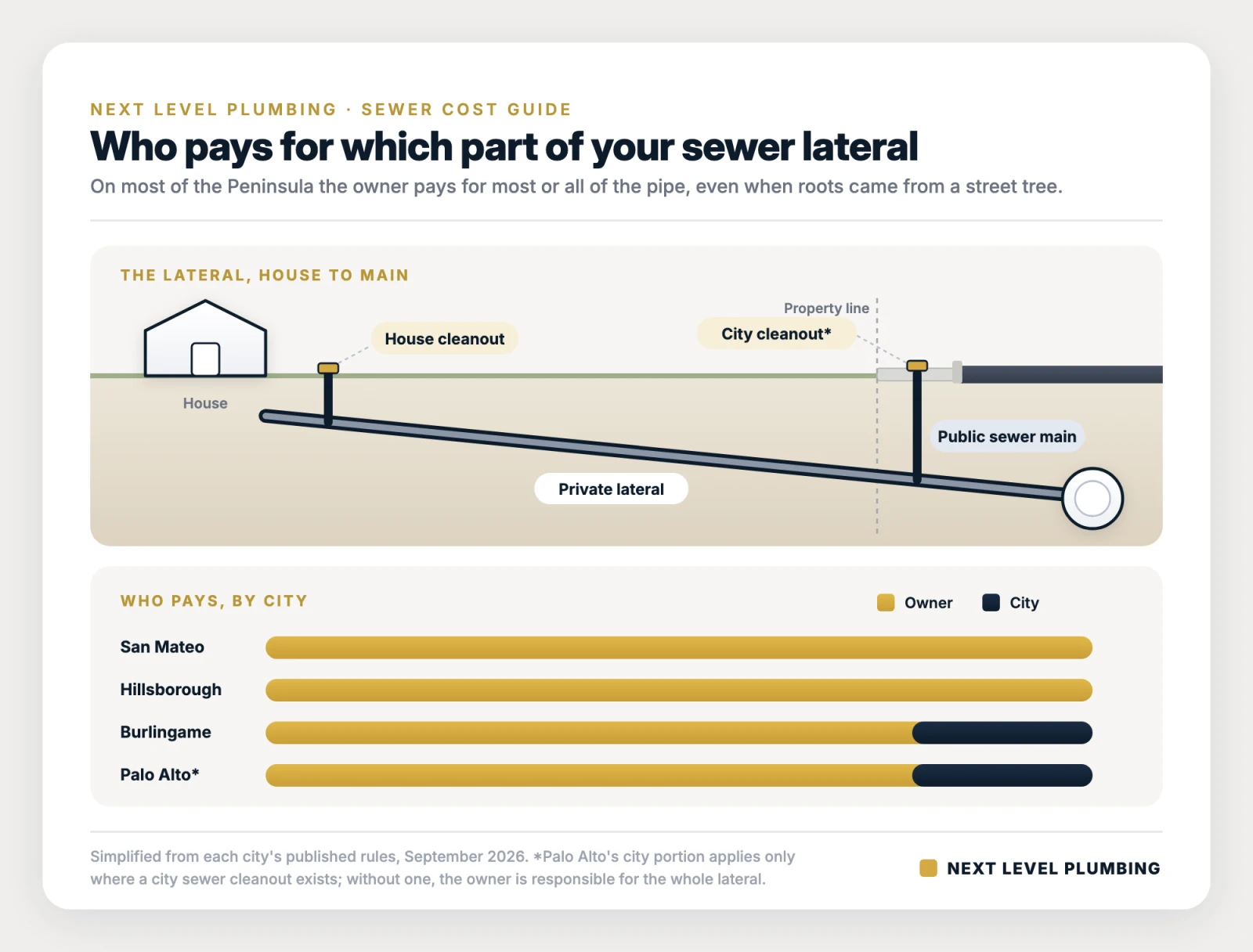
On most of the Peninsula, the property owner pays for the sewer lateral even when the roots came from a street tree. What decides the bill is where your city draws the ownership line, and that line moves from city to city.
- San Mateo defines the private lateral as running from the building all the way to, and including, its connection at the public sewer main.
- Burlingame maintains the piping from the sewer cleanout at the city right of way to the main. Everything between that cleanout and your house is yours.
- Palo Alto owns the lower lateral, from the main up to the first city sewer cleanout, under its Rule 23 when a city cleanout exists. Without one, the owner is responsible for the whole lateral.
- Hillsborough states that maintenance and repair of sewer laterals are the property owner's responsibility, and tells residents that roots are the most common cause of lateral damage.
The Forest Service review found the same pattern nationally: cities usually pay only for the public part of the system, and because most root intrusion happens in the service pipes running through yards, residents end up carrying most of the repair cost.
Cost sharing helps, with limits. The City of San Mateo's sewer lateral cost sharing program reimburses 50% of the lowest bid, up to $2,500, while funding lasts, and it is taking applications for fiscal year 2026/27. It does not cover spot repairs, partial replacements, or root work. Millbrae publishes a rebate of 20%, up to $2,000, for broken, separated, or code-upgrade lateral work, first come, first served, so check the current terms with the city before you sign a contract.
Picture a San Mateo homeowner who pays to clear roots three times, then replaces the full lateral from the house to the main. None of the clearing visits qualify for the city program. The full replacement can, for half the lowest bid up to $2,500, as long as the application goes in while funding remains. If a city street tree is involved, call public works before you authorize work and ask how the city handles damage from its trees.
Root Killers and Copper Sulfate: What Is Legal Here
Copper sulfate root killers are illegal for sewer and drain root control in all nine Bay Area counties. California Code of Regulations, Title 3, Section 6920 prohibits using, possessing for use, or selling copper sulfate to control roots in sewers and drains in Alameda, Contra Costa, Marin, Napa, San Francisco, San Mateo, Santa Clara, Solano, and Sonoma counties.
That matters because a lot of national advice, from cost guides to forum threads, still tells homeowners to flush copper sulfate down the toilet every year. It is out of date here. Other root treatments are sold, and they can slow regrowth, but they work the same way cutting does: they deal with the roots and leave the gap in the pipe. If you are paying for chemical treatment on a schedule, run the same break-even math you would for clearing.
Tree Roots in Sewer Lines: Frequently Asked Questions
HomeAdvisor and Fixr both put removal of a standard root intrusion at $100 to $600 nationally. Most jobs also involve a camera inspection, which HomeAdvisor prices at $100 to $500. Bay Area labor costs push local quotes toward the top of those ranges, and the price only covers clearing the pipe, not repairing the joint the roots came through.
Usually not under a standard policy, because root intrusion is treated as gradual damage and ordinary maintenance. Many insurers sell an optional service line endorsement that covers buried water and sewer lines, including root damage. Read your policy or ask your agent before you assume either way.
The usual signs are slow drains all over the house, gurgling toilets, and backups at the lowest drain or at the cleanout, often coming back after the line was cleared. Only a camera inspection confirms roots and shows where they are getting in, which is the information you need to price a fix.
Not in the Bay Area. California Code of Regulations, Title 3, Section 6920 prohibits using, possessing for use, or selling copper sulfate for root control in sewers and drains in Alameda, Contra Costa, Marin, Napa, San Francisco, San Mateo, Santa Clara, Solano, and Sonoma counties. Other root treatments exist, but like cutting, they treat the roots and leave the gap in the pipe.
Lining puts a continuous new pipe inside the old one, which closes the joints roots use to get in. That is why it is the usual fix for a rooted pipe that is still round and still slopes toward the street. The connections at each end still need to be sealed properly, so ask the contractor how they handle them.
Not as a first move. Taking the tree out does not repair the cracked or open joint, and the pipe will still need clearing or fixing. Many Peninsula cities also regulate removal of larger trees, so check your city's rules before you cut. Fix the pipe first, then decide about the tree.
Related Bay Area Cost Guides
Managing a commercial building or an apartment complex? Our guide to commercial hydro jetting covers when bigger lines need more than a cable machine. And if you own the house, the sewer lateral is one of two buried lines that are yours. Our main water line replacement cost guide covers the other one.
Clearing Roots or Replacing the Line? Talk to Next Level Plumbing
The right answer for a rooted sewer line starts with camera footage you can see for yourself. We run the camera, show you where the roots are getting in, and tell you plainly whether clearing, lining, a spot repair, or a new lateral makes sense for how long you plan to stay. Start with our sewer line repair and replacement team, or call (650) 532-4866 from anywhere on the Peninsula.